House Wiring 101: A Complete Beginner's Guide
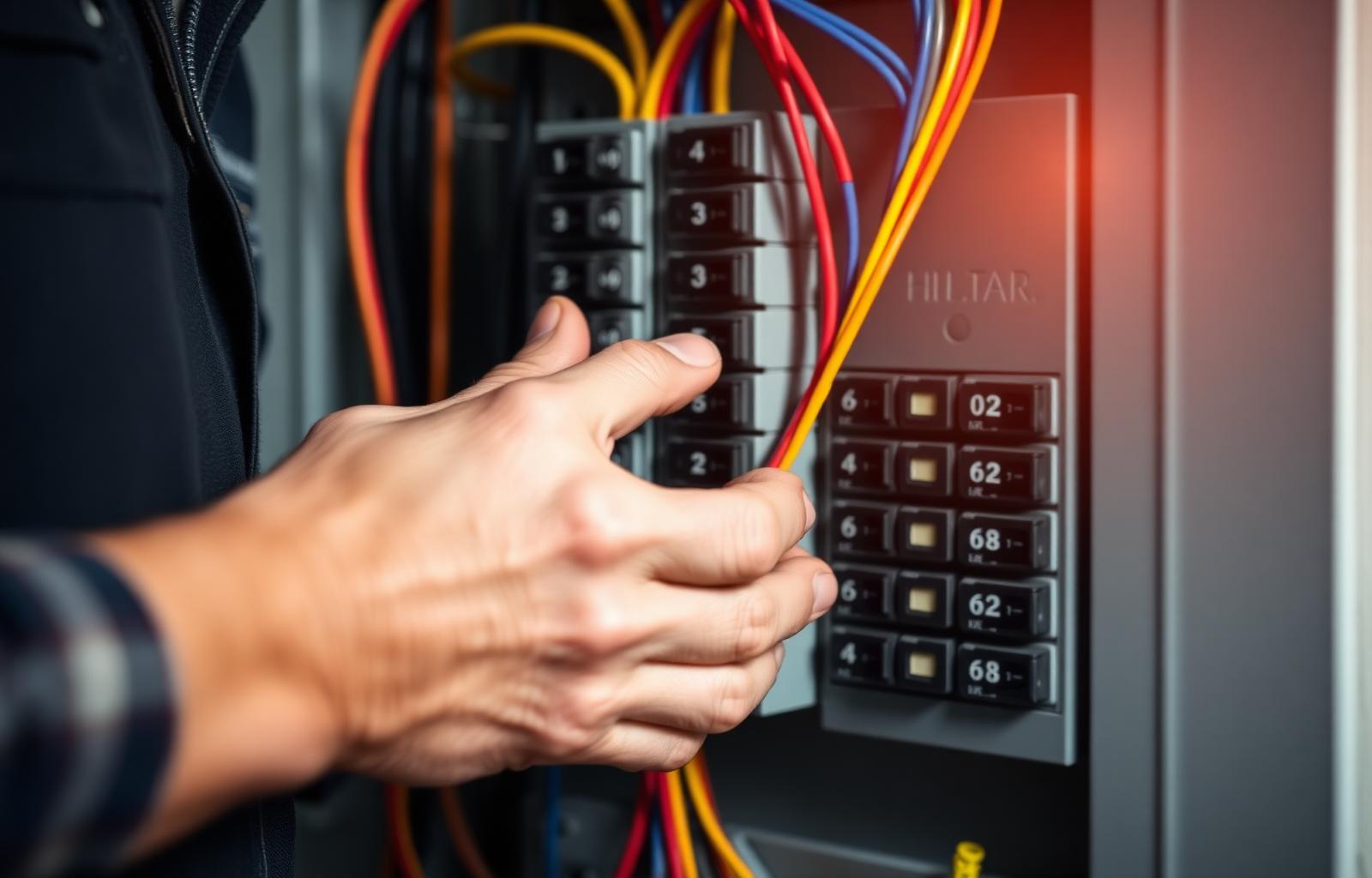
How your home's electrical system works
Power arrives at your house through a service drop or underground lateral and enters the main breaker panel, the gray metal box that is the heart of the system. Inside, two hot bus bars each carry 120 volts relative to neutral. A standard breaker taps one bus bar to make a 120-volt circuit for outlets and lights; a double-pole breaker taps both to make a 240-volt circuit for heavy appliances like dryers and ovens.
From each breaker, a cable runs out to serve one circuit, which is simply a loop: hot wire carries power out to the devices, neutral wire carries it back, and a bare or green ground wire provides a safety path that should normally carry no current at all. Every outlet, switch, and light in your home sits on one of these circuits. When a breaker trips, it is doing its job: it detected more current than the wires can safely carry and cut the power before the wires overheated.
The panel also has a main breaker that kills power to everything. Learn where your panel is and label every breaker. In an emergency, or before any electrical work, you want to find the right breaker in seconds, not minutes.
Wire colors and gauges explained
In modern North American wiring, colors have standard meanings. Black (or red as a second hot) is the hot wire carrying power. White is neutral, the return path. Bare copper or green is ground, the safety path. These colors are a convention, not a guarantee, especially in older homes, so always verify with a tester before touching anything.
Wire gauge, measured in AWG, tells you how thick the conductor is, and lower numbers mean thicker wire. The two sizes you will see most are 14 AWG, used for 15-amp lighting and outlet circuits, and 12 AWG, used for 20-amp circuits in kitchens, bathrooms, and garages. Thicker wire safely carries more current, which is why the breaker size must always match the wire: a 20-amp breaker on 14-gauge wire is a fire waiting to happen because the wire will overheat before the breaker ever trips.
Cable sheathing has its own language too. Non-metallic sheathed cable, commonly called Romex, has a printed label like 12/2, meaning 12-gauge with two current-carrying conductors plus ground. Read the label before you buy; grabbing the wrong roll at the store is an expensive mistake.
Breakers, outlets and switches basics
A circuit breaker is a reusable safety switch. Unlike the old screw-in fuses, you reset it by flipping it fully off and then on. Breakers protect wires, not people and not your electronics; that distinction matters when we talk about GFCI outlets later.
Standard duplex outlets have brass screws for hot wires, silver screws for neutral, and a green screw for ground. The smaller slot is hot, the larger slot is neutral, which is why some plugs are polarized and only fit one way. A basic light switch simply interrupts the hot wire to a fixture; when it is off, the fixture has no power, but the box itself may still have live wires, so never assume a box is dead because the switch is off.
Three-way switches, the pairs that control one light from two locations, confuse beginners because both switches have three terminals plus ground. The trick is the common terminal, usually a darker screw: the hot feed or the wire to the light lands there, and the two traveler wires connect the switches to each other. Take a photo before disconnecting anything, and label each wire with tape.
Planning a simple circuit the right way
Before adding anything, do the load math. Add up the wattage of everything the circuit will serve and divide by 120 to get amps. A bedroom circuit with a few lights and phone chargers might draw 3 amps; a space heater alone draws 12.5. Keep continuous loads under 80 percent of the breaker rating: 12 amps on a 15-amp circuit, 16 on a 20-amp circuit.
Map the circuit on paper first. Decide where the homerun cable enters from the panel, then daisy-chain devices in a logical order that minimizes cable runs through finished walls. Keep high-draw appliances on dedicated circuits rather than sharing with general outlets. Kitchens and bathrooms need 20-amp small-appliance circuits by code, and for good reason.
Buy a little more cable than you measured; fishing wire through walls always takes more than the straight-line distance. And check your local code before you start. Many jurisdictions allow homeowners to do their own wiring with a permit and inspection, while some require a licensed electrician for panel work. The permit is not bureaucracy for its own sake; the inspector catches the mistakes that burn houses down.
Safety rules professionals never break
Rule one is absolute: turn off the breaker, then verify with a non-contact voltage tester that the wires are actually dead. Test the tester on a known-live outlet first so you know it works. People get hurt trusting a mislabeled breaker panel.
Rule two: never work alone on anything beyond swapping an outlet. Have someone nearby who knows where the panel is. Rule three: keep one hand in your pocket when probing live circuits is unavoidable during testing; it is an old electrician's habit that keeps current from crossing your chest.
Use insulated tools rated for the voltage, wear safety glasses when cutting into boxes, and never stand on a wet floor while doing electrical work. Aluminum wiring, found in many homes built in the late 1960s and 1970s, needs special connectors and is a job to discuss with an electrician rather than DIY. Respect the limits of your knowledge; electricity rewards humility and punishes confidence.
When to call a licensed electrician
DIY has a clear boundary, and knowing it is what separates a smart homeowner from a dangerous one. Call a professional for anything inside the main panel beyond flipping breakers, for new circuits run from the panel, for 240-volt appliance circuits, and for any work where you are unsure what you are looking at.
Also call one if you find scorched wire insulation, melted outlet faces, breakers that trip repeatedly, lights that flicker across multiple rooms, or a buzzing panel. Those are symptoms of problems that simple part-swapping will not fix, and they can indicate loose service connections that are genuinely dangerous.
A good electrician will also pull the permit and arrange the inspection, which protects you twice: the work gets a second pair of expert eyes, and you have documentation that the work was done to code, which matters for insurance and resale. The service call fee is the cheapest insurance you will ever buy.