How to Install a Whole-House Surge Protector: A Beginner's Guide
What a Whole-House Surge Protector Actually Does (and What It Does Not)
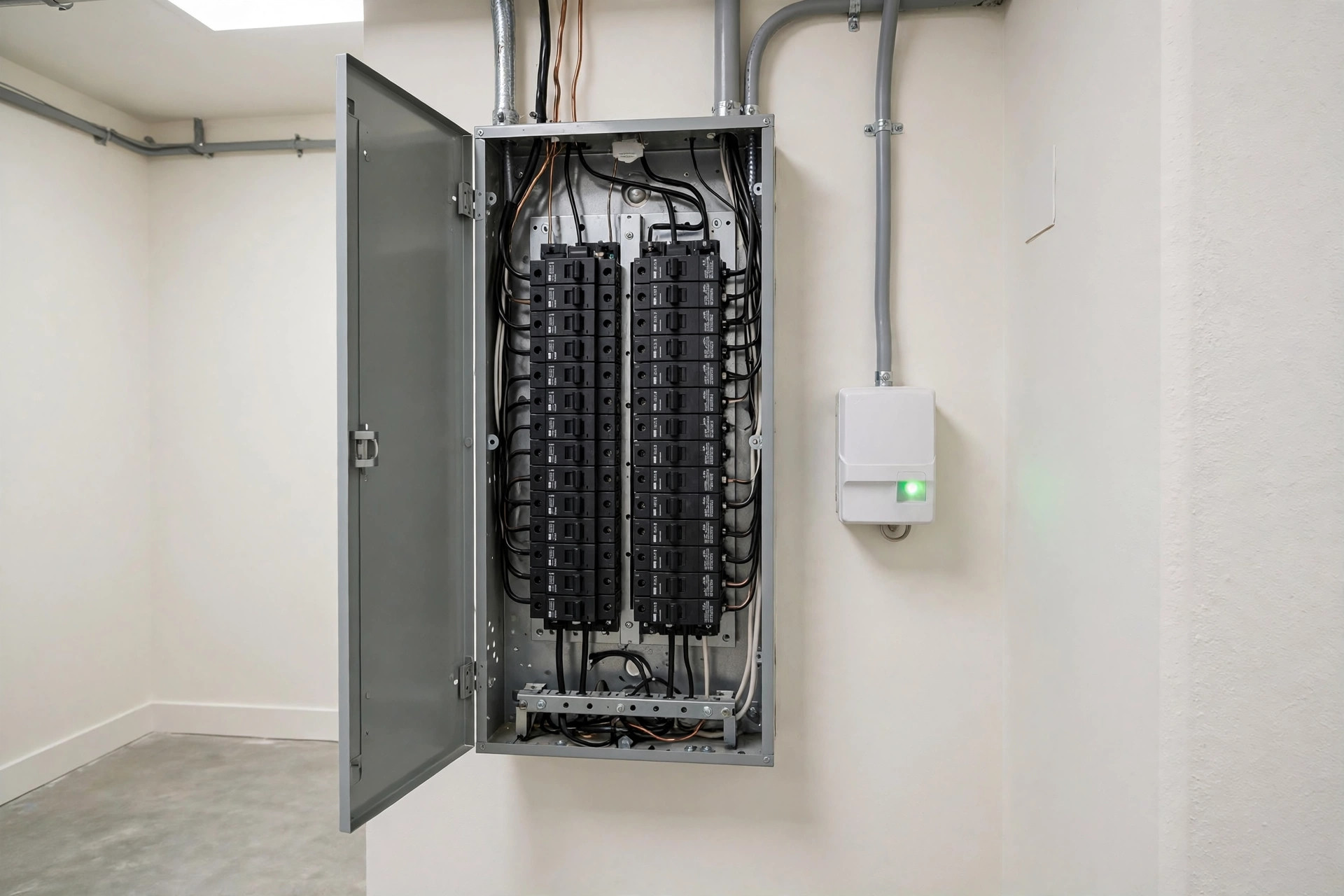
A whole-house surge protector, technically called a surge protective device (SPD), sits at or beside your main electrical panel and diverts excess voltage safely to earth before it can reach the circuits inside your home. When a surge arrives — from a lightning strike nearby, the power company switching equipment, or a large appliance cycling off — the device clamps the voltage and shunts the excess energy away in nanoseconds.
It is important to understand the limits. A whole-house unit handles big external surges, but smaller internal spikes from motors and compressors still occur within the house. That is why electricians recommend a layered approach: the whole-house protector as the first line of defence, plus point-of-use surge strips on expensive or sensitive gear such as computers, televisions, and smart-home hubs. No surge protector, however, can stop a direct lightning strike to your house — that kind of energy will overwhelm anything on the market.
What the device does give you is dramatically reduced risk from the everyday surges that quietly degrade electronics over time. Many homeowners only discover they needed one after a storm takes out a fridge control board, a garage door opener, or a home cinema setup. Installing the protection before that happens is one of the cheapest insurance policies your panel can carry.
Choosing the Right Surge Protector for Your Home
Start with the type. Type 1 devices install on the utility side of your main breaker and are usually fitted by the power company or an electrician; Type 2 devices install inside your own panel on a dedicated double-pole breaker and are the standard choice for a homeowner install. Type 3 devices are your ordinary plug-in strips. For this guide, you want a UL 1449-listed Type 2 unit rated for 120/240 V split-phase service, which is what the vast majority of UK homes — no, US homes — use.
Look at three numbers on the packaging. The voltage protection rating (VPR) tells you how much voltage the device lets through before clamping — lower is better, and 700 V or less is a solid target. The nominal discharge current rating tells you how much surge current it can handle repeatedly, and the maximum surge current rating (often 40–108 kA) tells you how large a single event it can survive. As a rule of thumb, a unit rated for at least 40 kA of surge current suits most homes, while homes in lightning-prone areas should aim higher.
Check practical details too: make sure the device physically fits your panel brand and has room on the bus bars, confirm it comes with a warranty that covers connected equipment (many manufacturers offer several thousand pounds of equipment coverage), and prefer models with an indicator light or audible alarm that tells you when the protection has been spent. A surge protector is a consumable — after a large surge it may have sacrificed itself silently, and a dead indicator is your signal to replace it.
Safety First: Read This Before Opening Your Electrical Panel
This project involves working inside your main electrical panel, where live mains conductors are present. You will shut off the main breaker before you begin, but the large service conductors coming into the top of the panel remain live at all times — even with the main breaker off — because they are on the utility side. Those lugs can kill you. Never touch them, never let a tool touch them, and keep your hands clear of the top section of the panel throughout the job.
Use a non-contact voltage tester to verify that the branch circuits are dead after switching off the main breaker, and re-test before you touch anything. Work with one hand when you can, wear insulated gloves and safety glasses, stand on a dry surface, and never work in a damp environment or while tired. Keep a torch handy because the lights in the house will be off — you switched off the main breaker, after all.
Know your limits. If your panel is old, corroded, has no spare breaker slots, or uses a fuse box, this is not a beginner project — call a licensed electrician. The same applies if you feel unsure at any point, or if your local building code requires a permit for panel work (some jurisdictions do). An electrician typically completes this job in under an hour, and the cost of professional installation is small compared with the risk of getting it wrong.
Step by Step: Installing a Type 2 Surge Protector
With the main breaker off and the panel verified dead with your tester, remove the panel cover screws and set the cover aside. Decide where the device will live: most Type 2 units mount through a knockout on the side or bottom of the panel, sitting just outside it so the indicator light stays visible. Remove the appropriate knockout with a screwdriver — quarter-turn knockouts pop out easily, while stubborn ones can be loosened by rocking them back and forth.
Mount the device according to its instructions, feeding its wires through the knockout into the panel. Keep every wire as short and as straight as possible — under 30 cm is the widely quoted ideal — because excess wire length reduces the protector's effectiveness against fast surges. Most units have four wires: two black (or one black and one red) hots, one white neutral, and one green or bare ground.
Now make the connections. Land the two hot wires on a new double-pole breaker (typically 20–50 A as specified by the manufacturer) installed in two adjacent slots as close to the main breaker as possible. Connect the white wire to the neutral bus bar and the green wire to the ground bus bar, making sure each lands on its own terminal and is tightened to the panel's specified torque. Double-check every terminal: a loose neutral or ground connection can leave the protector unable to divert a surge at all.
Replace the panel cover carefully, making sure no wires are pinched, then restore the main breaker. The protector's indicator light should glow green (or whatever colour the manual specifies) within a few seconds, confirming it is powered and protecting. If it does not light up, switch the main breaker off again, re-check your connections against the wiring diagram, and confirm the dedicated breaker is fully seated — then try once more before calling an electrician.
Testing, Maintenance, and When to Call an Electrician
A whole-house surge protector needs almost no maintenance, but it does need occasional attention. Glance at the indicator light every few months — daily is unnecessary, but after any nearby lightning strike or extended power outage, check it right away. If the light is off, the unit has either lost power (check its breaker) or absorbed a surge beyond its rating and must be replaced. Most manufacturers sell direct replacement modules or whole units, and swapping one follows the same safe procedure you just learned.
Remember the layered strategy: keep your plug-in surge strips on the valuable gear too, and replace those every few years or after a known surge event, since they wear out silently. If your home has sub-panels — for a garage, extension, or outbuilding — consider a second protector there if the outbuilding holds expensive equipment. And if you ever upgrade your panel, buy a new protector matched to it rather than reusing the old one.
Call a licensed electrician without hesitation if you encounter anything unexpected: scorch marks, buzzing, a burning smell, a breaker that will not reset, or wires you cannot positively identify. Panel work rewards caution and punishes guesswork. Done properly, though, a whole-house surge protector quietly does its job for years — the best kind of DIY project is the one you never have to think about again.